
Sep 18th 2026

How To Install The Triggered Company Partisan Disruptor Forced Reset Trigger
The Partisan Disruptor is a drop in 3-position forced reset trigger cassette designed for AR-15 mil- ...
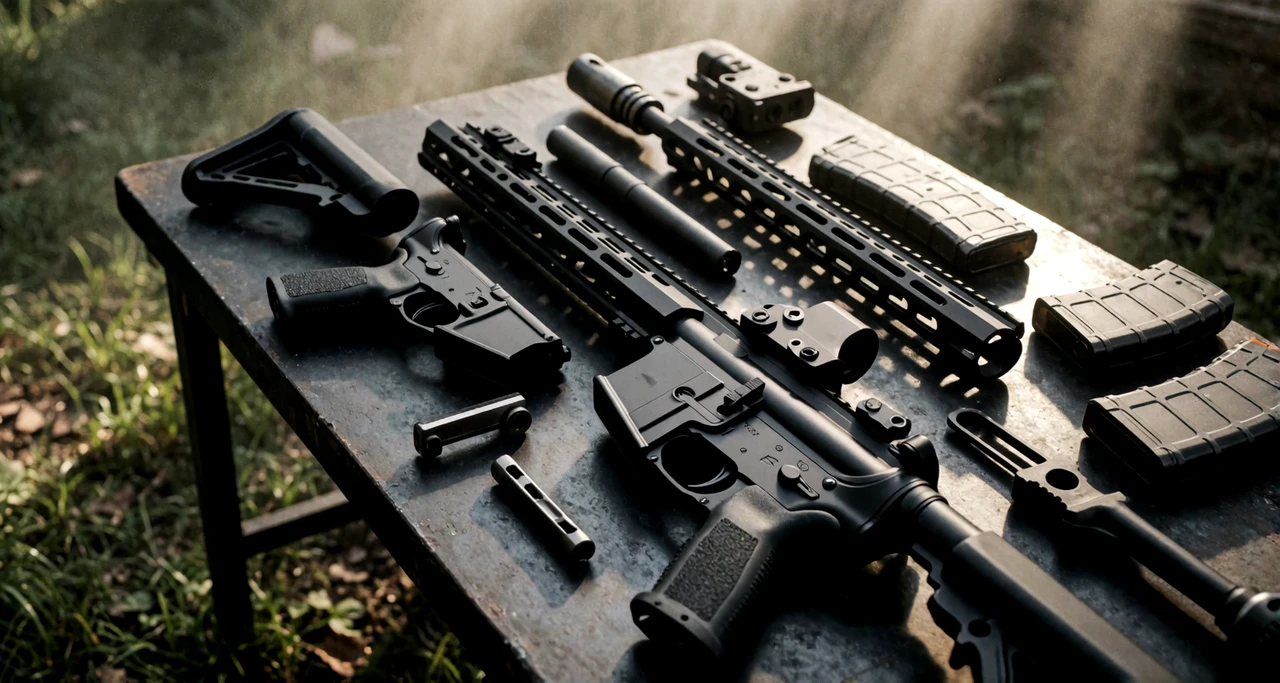

NSPEC Innovations carries a full selection of AR parts for the AR-15, AR-10, and AR-9 platforms. Whether you're building a rifle from the ground up or upgrading key components for better accuracy and reliability, you'll find bolt carrier groups, handguards, barrels, triggers, charging handles, buffer kits, and complete upper receivers from trusted manufacturers. Browse by platform below or use the filters to find exactly what your build requires.

NSPEC Innovations carries a full selection of AR parts for the AR-15, AR-10, and AR-9 platforms. Whether you're building a rifle from the ground up or upgrading key components for better accuracy and reliability, you'll find bolt carrier groups, handguards, barrels, triggers, charging handles, buffer kits, and complete upper receivers from trusted manufacturers. Browse by platform below or use the filters to find exactly what your build requires.
The AR-15 remains the most popular rifle platform in the United States, and for good reason. Its modular design means every component can be swapped, tuned, or upgraded to match your shooting style. NSPEC stocks AR-15 barrels in multiple lengths and calibers (including 5.56 NATO, .223 Wylde, .300 Blackout, and 7.62x39), bolt carrier groups, M-LOK and free-float handguards, muzzle brakes, lower parts kits, triggers, charging handles, and complete upper receivers. We also carry AR-15 build kits for those who want a streamlined path to a finished rifle or pistol.
For shooters who need the added power of .308 Winchester or 6.5 Creedmoor, the AR-10 platform delivers. Our AR-10 parts inventory includes barrels, bolt carrier groups, buffer kits and parts, handguards, lower parts kits, muzzle brakes, triggers, charging handles, and complete upper receivers. The AR-10 shares a similar manual of arms with the AR-15 while offering significantly more capability at longer distances, making it a favorite for precision shooting and hunting applications.
The AR-9 brings pistol-caliber versatility to the AR platform. Chambered in 9mm, AR-9 builds are ideal for home defense, competition shooting, and range training where reduced recoil and lower ammunition costs are a priority. We carry AR-9 barrels, bolt carrier groups, buffer kits, handguards, magazines, muzzle brakes, lower parts kits, triggers, charging handles, and complete upper receivers. Our AR-9 build kits make it easy to assemble a reliable pistol-caliber carbine or pistol from scratch.
Every AR build starts with a set of core components that determine how the rifle performs. Understanding what each part does helps you make better purchasing decisions and build a more reliable firearm.
Upper Receivers and Barrels form the business end of your AR platform. Barrel length, profile, twist rate, and chamber specification all influence accuracy, velocity, and overall handling. A 16-inch midlength gas system in .223 Wylde, for example, offers a versatile balance of accuracy and maneuverability for most shooters. Complete upper receivers simplify the build process by shipping as a ready-to-install assembly with barrel, handguard, gas system, and bolt carrier group already fitted and headspaced.
Bolt Carrier Groups (BCGs) are the heart of the AR's cycling system. A quality BCG ensures reliable feeding, extraction, and ejection with every round. Coatings like nickel boron and phosphate improve corrosion resistance and ease of cleaning. Whether you're running a standard M16-profile BCG in an AR-15 or a larger DPMS-pattern carrier for your AR-10, choosing a properly staked, MPI-tested bolt carrier group is one of the most important decisions in any build.
Handguards protect your hands from barrel heat while providing mounting points for accessories like lights, lasers, vertical grips, and bipods. Free-float handguards improve accuracy by eliminating contact between the barrel and the rest of the rifle. M-LOK has become the standard attachment system across the industry, offering a lightweight and low-profile way to mount accessories exactly where you need them.
Triggers have a direct impact on shot placement. Upgrading from a standard mil-spec trigger to a drop-in or match-grade trigger can dramatically improve your shooting experience. Single-stage triggers offer a clean, consistent break, while two-stage triggers provide a distinct take-up before the wall for more controlled precision shooting.
Buffer Systems and Stocks manage recoil and determine the overall length of pull for your rifle or pistol. Properly tuning your buffer weight and spring to match your gas system and ammunition keeps the action cycling smoothly and reduces felt recoil. Carbine, rifle, and pistol-length buffer tubes each serve different build configurations.
Lower Parts Kits and Charging Handles round out the essentials. A complete lower parts kit provides every pin, spring, detent, and selector needed to finish a stripped lower receiver. Ambidextrous and extended charging handles improve ergonomics and make it easier to manipulate the action under stress or while running optics with low clearance.
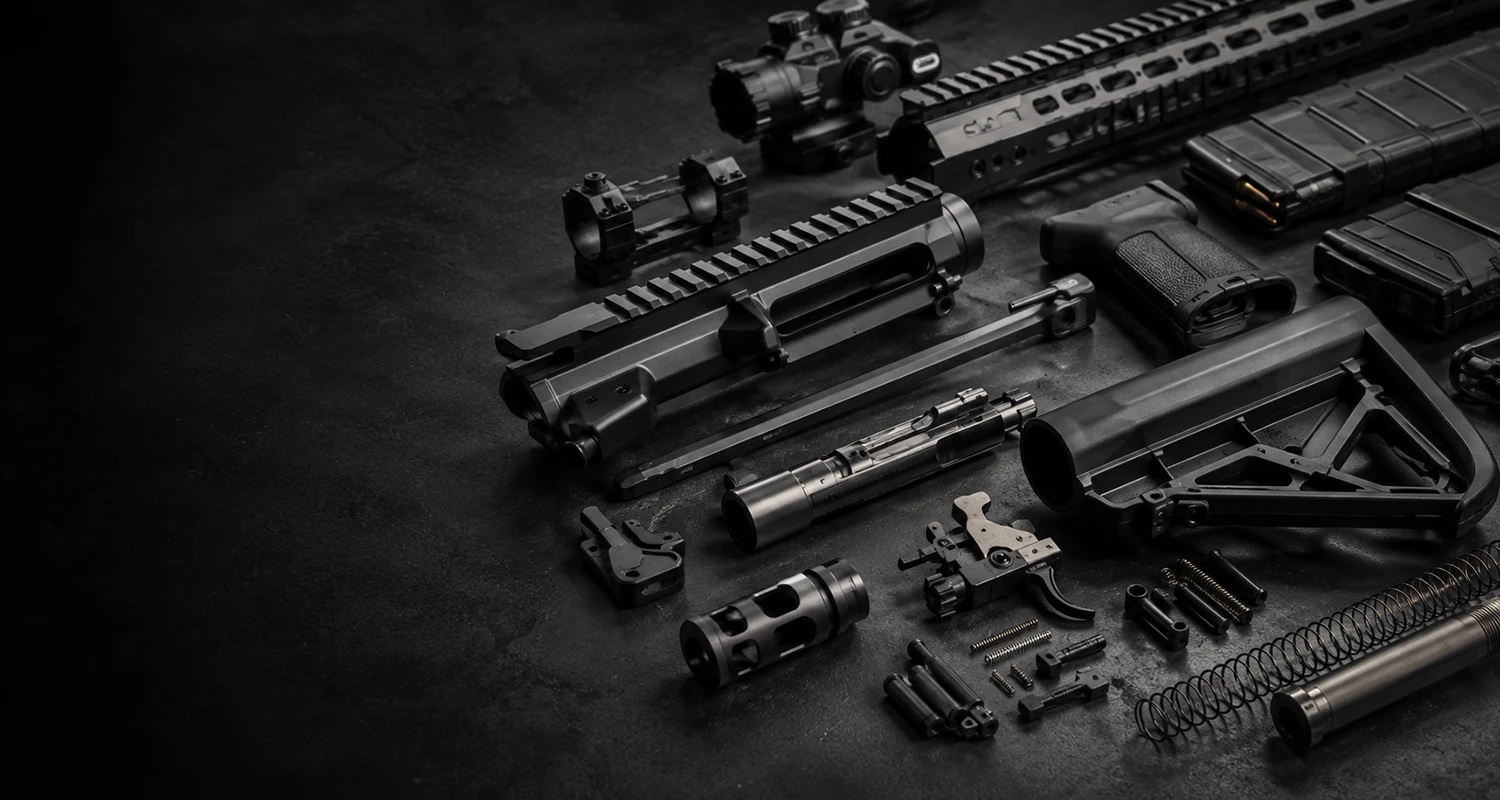
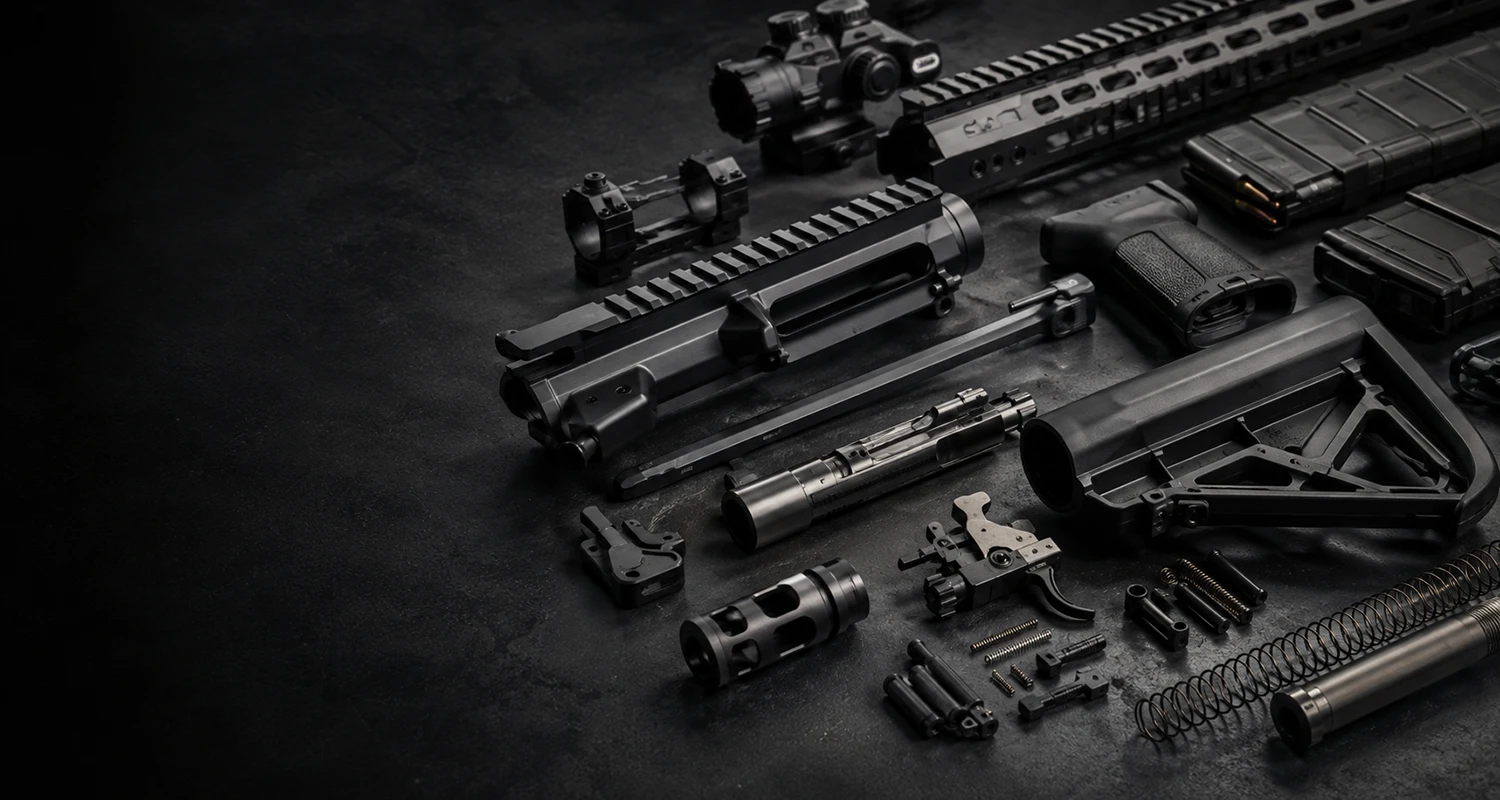
A complete AR build requires a stripped or complete lower receiver, lower parts kit (with trigger group), buffer tube assembly, stock or brace, upper receiver, barrel, gas block and gas tube, handguard, bolt carrier group, charging handle, and muzzle device. Many builders start with a complete upper receiver paired with a stripped lower to simplify the process, since the upper arrives assembled and headspaced.
Some components are cross-compatible, but most are platform-specific. Small parts like pistol grips, safety selectors, and some trigger groups often work across AR-15 and AR-9 platforms. AR-10 parts, however, are typically larger and require components designed for the .308/7.62 platform. Buffers, buffer tubes, bolt carrier groups, barrels, and handguards are almost always specific to each platform. Always confirm compatibility before purchasing.
Mil-spec buffer tubes have a 1.148-inch outer diameter with a slightly angled back, while commercial-spec tubes measure 1.168 inches with a flat back. Mil-spec is the industry standard for most quality builds, and mil-spec stocks will not fit properly on commercial tubes (and vice versa). When in doubt, go mil-spec for the widest compatibility with aftermarket stocks and accessories.
No FFL is required for most AR parts. Components like barrels, bolt carrier groups, triggers, handguards, stocks, and lower parts kits ship directly to your door. The only component that legally qualifies as a firearm (and requires an FFL transfer) is a serialized lower receiver. Complete upper receivers, despite containing the barrel, do not require an FFL.
Barrel length affects velocity, accuracy, maneuverability, and legal classification. For AR-15 rifles, 16 inches is the minimum length that avoids NFA short-barreled rifle regulations without pinning and welding a muzzle device. Shorter barrels (10.5 to 14.5 inches) are common on AR pistol configurations. For AR-10 builds, 18- to 20-inch barrels maximize the ballistic potential of .308 and 6.5 Creedmoor cartridges. AR-9 barrels are typically shorter, ranging from 4.5 to 8.5 inches, since 9mm reaches near-maximum velocity in a relatively short barrel.
A free-float handguard attaches only to the upper receiver barrel nut and makes no contact with the barrel, which eliminates external pressure on the barrel and improves accuracy. A drop-in handguard uses the delta ring assembly and front sight base for support, which means it contacts the barrel at two points. Free-float handguards are preferred for precision builds, while drop-in handguards work well for budget builds and rifles with fixed front sight bases.
.223 Wylde is a hybrid chamber specification designed to safely fire both .223 Remington and 5.56 NATO ammunition while optimizing accuracy for .223 match-grade loads. A 5.56 NATO chamber has a longer throat that handles the higher pressures of 5.56 ammo but may sacrifice some accuracy with lighter .223 loads. If you want the flexibility to shoot both cartridges with the best possible accuracy, .223 Wylde is the go-to chamber choice.
Gas system length should match your barrel length for reliable cycling and manageable recoil. Pistol-length gas systems pair with barrels under 10 inches. Carbine-length works best with 10- to 14.5-inch barrels. Mid-length gas systems are ideal for 14.5- to 18-inch barrels and offer a smoother recoil impulse than carbine-length on 16-inch barrels. Rifle-length gas systems pair with 18-inch and longer barrels. Mid-length on a 16-inch barrel is widely considered the best all-around combination for most shooters.
MPI (Magnetic Particle Inspection) is a non-destructive test that detects surface and near-surface cracks in the bolt by magnetizing the metal and applying ferrous particles. Cracks show up as visible lines where particles cluster. HPT (High Pressure Testing) fires a proof round that generates significantly higher chamber pressure than standard ammunition to verify the bolt can withstand extreme stress. A BCG that passes both MPI and HPT testing has been individually verified for structural integrity and pressure tolerance, which is the standard you should look for in any quality build.
A complete upper receiver is the faster and often more reliable option, especially for first-time builders. The barrel is already installed, headspaced, and timed with the gas system, which eliminates the need for specialized tools like a torque wrench, vise block, and barrel nut wrench. Building from individual parts gives you full control over every specification (barrel profile, gas block type, handguard length, muzzle device) and is typically the better route for experienced builders who want a specific configuration that isn't available as a factory assembly.
The Partisan Disruptor is a drop in 3-position forced reset trigger cassette designed for AR-15 mil- ...
Running a forced reset trigger—such as the Partisan Disruptor—fundamentally changes the cycling dyna ...
When it comes to modernizing standard AK-pattern rifles, gun owners historically faced a dilemma: se ...
If you're in the market for a forced reset trigger modification, chances are you've heard of the Hof ...


Get the latest updates on new products and upcoming sales